
A note before you start:
This post discusses the differences between kava and alcohol, and shares personal accounts from people who have used kava as part of cutting back on their drinking. We are not medical professionals and we don't make therapeutic claims about kava. The personal stories below are individual accounts, not medical recommendations. If you're struggling with alcohol use, please talk to your GP or a qualified addiction professional rather than treating any beverage as a remedy.
Introduction
Some of the most commonly asked questions we get about kava revolve around how it compares to alcohol, whether it can be used as an alternative to alcohol, and whether the two can be mixed. In this post we look at all three. More specifically, we want to focus on the idea of using kava as a replacement for or perhaps an alternative to alcohol. We discuss the pros, the cons, and share a good dose of observations and personal stories from kava drinkers. We also briefly touch on the separate topic of using alcohol together with kava.
Before we start, we want to make one thing clear: we don't want to demonise alcohol. Alcohol consumption has a rich and diverse culture and history. Alcohol in various forms has its place in our society and it can be enjoyed responsibly by a great number of adults around the world. However, this doesn't mean that it works for everyone, or that it is the best substance to use in many of the circumstances in which it is currently used. Our purpose here is to demonstrate that kava can offer some unique advantages over alcohol as a calming evening beverage. Some people use kava socially or recreationally as an alternative to alcohol; some people we've heard from also describe using kava as part of cutting back on their drinking. The personal accounts below are theirs, not ours, and we're not in a position to make medical claims about kava as a treatment.
Why people use alcohol
For most people this question doesn't require an answer, but it's worth remembering that alcohol is so common in most Western cultures, that we may not even realise how widespread and deeply ingrained its usage is in our society. Alcohol has been used throughout history for ceremonial, religious, medicinal, symbolic and, above all, recreational and social purposes. In New Zealand, alcohol accompanies weddings, birthdays, religious and political ceremonies. It is there during romantic encounters, business discussions, formal and informal gatherings. It is believed to facilitate the flow of discussion (even though it hardly helps to improve the quality of any discussion). It is used for its taste and as part of more or less elaborate meals (even though it may actually interfere with digestion). It is used to combat (or rather dull) both physical and emotional pain. It is used to calm (or again, perhaps to dull or mask) stress, and to facilitate falling asleep (even though it has been shown to decrease the overall quality of one's sleep).
How does kava differ from alcohol?
Traditionally, on the islands, kava has been used for many different purposes, ranging from ceremonial through medicinal to recreational. It can be argued that in many societies across Oceania it has played a role similar to that played by alcohol in Western cultures. Both kava and alcohol are plant-based, both are known for relaxing effects, both are consumed predominantly in the afternoon and evening, and both are often consumed in a social setting. However, there are several important differences between kava and alcohol:
1. Kava's effects are qualitatively different, not just quantitatively
The effects produced by kava depend on a number of active compounds (kavalactones), their specific distribution and concentration (which differs from one cultivar to another), the synergy between them and other phytochemicals, and the form and style in which the plant is consumed (see our piece on different ways of drinking kava). Some kavas are known to be more euphoric and mentally uplifting, others more sedating or mellowing. Some act quickly, others slowly creep up. The differences between cultivars are qualitative as well as quantitative. By contrast, alcohol's effects are caused by just ethanol. Different alcoholic beverages contain different levels of ethanol and different styles of drinking can result in different levels of intoxication, but we're talking about quantitative rather than qualitative differences.
2. Most users find kava's effects deepen with time and practice
Unlike with alcohol, most users find the effects of kava become stronger and deeper with time and practice. Many first-time users of kava either fail to feel anything or only experience very mild effects. This phenomenon is often referred to as "reverse tolerance" (meaning that the more kava one drinks over time, the less they need to feel and enjoy its effects) or "initial tolerance" (the latter perhaps a more accurate view that instead of an ever-increasing sensitivity to kava, there's simply an initial period of insensitivity that is followed by a high plateau of consistently good effects). Massey University Professor of Psychology Robert J. Gregory described it this way: "Over time, the kava experience is like learning to meditate. Repeated use, and the teaching of others, taught me how to savour that experience."
3. Kava is fundamentally a peaceful agent
Kava's consumption is universally associated with peaceful disposition and interactions. On the one hand, this is related to the fact that kava itself is known to produce a sense of calmness. On the other hand, it is related to the fact that kava is best enjoyed in a peaceful, serene ambiance. As noted by Professor Gregory:
"The kava meditation is like an altered state of consciousness. Men on Tanna [island in Vanuatu] describe it as being in touch with the supernatural. You think and listen to your thoughts. Sometimes it is like entering a light, relaxed dream. Some describe it as like looking into a mirror. One's mind goes beyond one's body and looks back. The effect is only maintained if there is peace and quiet. One effect is that one's life must be lived with peace and harmony, for otherwise the next kava experience would be interrupted by unpleasant thoughts. In this way kava presents a positive psychological benefit, for one is more likely to lead a non-violent life. This is in contrast with alcohol, which seems linked to violence, conflict and discord. Some of the 'big men' on Tanna ordered troublesome young men who were frequent users of alcohol to drink kava, curbing their violence."
In a similar vein, an American plant-medicine expert, Chris Kilham, explained that: "Kava tends one towards reflection and quiet conversation. The Ni-Vanuatu speak of 'listening to kava', a condition of peaceful quiet that follows the consumption of a few good shells. Kava replicates some dimension of the inner peace achieved through meditation very well. Good kava effortlessly induces a condition of pleasurable contemplation."
Unlike many alcohol-fuelled meetings, kava sessions are quiet and peaceful. Conversations are rarely loud, the music (if any) is generally played at low volume and of the relaxing type. Visitors to Vanuatu are often astonished to see large groups of young men and women at the local kava bars having quiet conversations, almost whispering. The more kava people drink, the more mellow and quiet they appear. This is a stark contrast to alcohol, which makes at least some people considerably louder and more agitated.
4. Kava is not physically addictive
Unlike alcohol, kava is not physically addictive. As explained by Dr Lebot: "By pharmacological standards, kava is not classified as a drug, as its consumption never leads to addiction or dependency." What is meant by this is that even those who consume kava over a long period of time and then stop, do not appear to experience any withdrawal effects. Furthermore, one does not seem to develop a tolerance to kava. In fact, kava can be characterised by the so-called "reverse tolerance", where new users require far greater amounts of the plant to feel any effects than those who drink it regularly. We've always been a bit fascinated by kava's lack of potential for causing addiction and contacted a known kava expert, Dr Mathias Schmidt, to ask his opinion. He told us:
"With respect to the pharmacology of kava, the mechanisms of action are not well known. Obviously this is a non-standard mechanism. There is one group that showed highly interesting and selective effects on certain ion channels related to the excitability of nerve cells. As there is a highly complex and extremely sophisticated distribution of such channels throughout our CNS, the effect could be self-controlled. This is obviously not the typical addictive mechanism of drug blocking or activating a receptor like the opioid receptors or GABA directly; it may be all about intracellular sodium and calcium concentrations at the right place. Very small concentration changes, huge overall effect, but no addiction. The ion channels don't multiply, they just open or close. That's different in typical addictions, where the number of receptors is regulated up- or downwards, which causes a problem the moment the challenge (the addictive drug) is withdrawn."
Whatever the exact reason, our own experience agrees with the view that kava usage does not lead to physical dependence or increased tolerance. At the same time, we are aware that kava, like many other things and activities, can be habit-forming and that it is important to ensure that one's kava consumption does not come at the expense of other responsibilities and obligations.
5. Kava can support deeper sleep
While many people might believe that alcohol can be helpful with falling asleep, research indicates that in most cases it can actually produce serious disturbance of sleep. In other words, even though some people might find it easier to fall asleep after an alcoholic drink, the quality of their sleep can be significantly reduced. By contrast, according to some limited research (see our separate post on kava and sleep quality) and anecdotal evidence, many kava drinkers describe noticing better sleep on kava nights, especially with the heavier cultivars.
Using kava as a replacement for alcohol
The above features make kava potentially attractive as an alternative to alcohol for some people. This is especially true for those who may want to cut down on their alcohol usage and those who are looking for something to help them relax at the end of a long day without clouding their judgement and affecting their sleep, well-being and interactions with friends and family. We're not in a position to make medical claims here, and we'd encourage anyone struggling with serious alcohol dependence to speak to a qualified professional. But we have heard from a lot of kava drinkers over the years who describe using kava as part of their own cutting-back routine, and their accounts are worth sharing.
Over the years we've noticed that many (if not most) of the non-Pasifika New Zealanders who decide to try kava do so because they're looking for a more benign alternative to alcohol, either because they're not happy with their own drinking patterns or because they can't stand alcohol's side-effects. Many do not set out to completely replace alcohol with kava, but with time kava becomes their overwhelming preference. This was our experience at the University of Auckland. What started off as a novelty alternative to after-work Friday beers became an overwhelming preference, not just at the university but also outside of it.
Personal accounts from kava drinkers
The accounts below were shared with us by friends and by people who posted on kava-focused online communities. We're sharing them because they highlight specific individual circumstances better than broader generalisations could. Editor's note: these are personal stories, not medical advice or claims about kava. We've lightly edited a few phrases for current NZ regulatory clarity but kept each writer's voice intact.
One of the most detailed stories was originally published on the Kava Forums:
Hopefully this helps anyone contemplating using kava as part of moving away from daily drinking. My story is simple and typical. I'm 48 now. Was never worse than a weekend warrior for many years. Something changed in my 30s and I became a daily drinker. Not the 1-2 beers a day drinker. A 3-4 beers + close to half a fifth of bourbon per day drinker.
I was functional. Always went to work. Rarely had a bad hangover. But was a slave to daily drinking. By 6pm my mouth was dry for the first drink. If I was working late or had to do something before I got home the craving would be at the front of my mind until I could get home and get relief. My father was an evening scotch drinker his entire adult life. Same kind of drinker as me. Everyday maintenance with roughly the same amount. I knew it was a problem for years because I couldn't go a day without drinking but I also knew my life wasn't spinning out of control so I could easily live with it.
During a routine physical in May of 2015 I got the news that my liver enzymes were out of whack and had to get an ultrasound. I was pretty nervous to be honest. All those years of drinking coming to a head with health problems. Not the type of news anyone wants to hear. Thankfully it was "only" stage 1 mild fatty liver. I confessed my drinking to my doctor (of course I never mentioned it before) and the plan of action was to abstain for 3 months and retest. Quitting was pretty easy after the first week. It's not hard to be motivated when you get a warning shot that your liver can't handle your habits. I lost weight, ate right, exercised, and got a clean bill of health 3 months later.
I swore I would never drink again. Then I thought I could drink moderately on occasion. Then I thought I could have 2 glasses of wine per day. Then I thought I could only drink bourbon on the weekends. The slippery slope of lying to myself and regressing right back to square 1. It happens so easily to countless people with drinking problems. For some of us there is no middle ground. We either drink or we don't. If we do drink we have to get a fix and not a taste. It's a progressive problem. Once you cross a line you are never the same. I crossed the line about 12-15 years ago. It is what it is and I'm good with it. For those who haven't crossed the line, stay the hell away from it. If you see yourself fast approaching the point of no return then do everything in your power to stay away.
At least for me going cold turkey is pretty easy at first. Uncomfortable? Heck yes. Unmanageable? Not really. After a week of fighting bad sleep and irritability things start feeling pretty normal with one exception. My 6-9pm "witching hour" is scribed into my mental code. Those cravings never left during my long sober stint in 2015. The cravings came and I pushed them aside. After 9pm or so I'm good to go. After my protracted 4-month relapse I took my last drink about a month ago. I came to understand that I'd fallen completely down the slippery slope and that's exactly where I swore I would never be again.
I'm always honest with myself. I like "altered states". I've done plenty of stuff in my past which I thankfully grew completely out of over the years. But I couldn't shake alcohol. Could I live a completely sober life from all substances forever? Yeah I probably could, but again, being completely honest, I really don't want to. I like to unwind at the end of the day with something other than reality. A break from it all. I have 4 kids and a complicated job. Letting it all go at the end of the day feels good. No two ways around it.
I researched kava last year during my sober spell. The liver scare articles turned me away. I already had a stressed liver. No sense adding to it. This time around I did more research and quickly came to understand I'd fallen victim to half-truths and misinformation. The strong message I saw after researching the second time was: stick with noble and stick with traditional and don't worry about anything.
I ordered various roots. My first package arrived Thursday last week. I had low expectations because of the reverse tolerance thing. I'm a lucky one. No reverse tolerance for me. I downed 2 shells in 30 minutes and sat on the couch. Oh boy did that feel good. I chose heady to start and I felt it for sure. Nice waves of relaxation and slight euphoria with no cravings to drink. It was 6pm and I was feeling great without drinking.
The next 4 nights were a perfect repeat. I get the heady/heavy thing now. Heavy isn't good for pre-dinner for me but it works great as a night cap. I had a test on Sunday watching my NFL team. I drank 2 shells right before the game and felt fantastic. No beer cravings whatsoever. I'm still very early into my kava drinking experiment but the initial results are far better than I anticipated. I've personally found a satisfying substitute for my evening alcohol routine. It's even better in some important ways. A good dose lasts a long time and you aren't chasing the buzz like with drinking. Great sleep and easy waking are pretty nice too.
One thing I have contemplated is that it's probably best for a heavy drinker to get away from drinking for a week or two before trying kava. Give your body a chance to adjust and heal a little without alcohol. Kava is subtle and won't address the heavy cravings that occur during the first week or two. That may discourage some people. Also, getting through reverse tolerance could be a challenge. My best guess to be successful is to commit to not drinking first, give yourself some straight sober time, and then use kava to help maintain the change.
Another story comes from a long-time kava drinker and reviewer:
Kava is such a satisfying alcohol replacement that I'm almost afraid of the word getting out. I have struggled with the bottle for many years. When I was in South Sudan and trying to block out some of the horrors I was experiencing day-to-day, I would often find solace in spirits. This bad choice came home with me, and for the past year or so I have been battling the bottle. I went for an extended period of time where I would only drink kava once a week, or sometimes even once every two weeks. But these days, I only allow myself alcoholic drinks on Fridays and Saturdays. Even then, I can only drink a couple of beers before feeling drunk, and then I feel sick in the night and the morning after. I actually think this is a good thing. When I first started weaning myself off, I suffered from crippling panic attacks and even dizziness. It was extremely eye-opening to come face to face with the depth of my reliance on alcohol. Kava really does take the edge off the symptoms. And now when I am tempted to get some drinks, I just knead up some kava. On a night-to-night basis, it works for me. My only caution is the initial cut-off period. If you have a serious dependency on alcohol, it will still be painful if you try to cut off alcohol immediately.
As always, be aware of the risks of battling alcohol. You can win some battles and then lose big, falling off and crumbling. Kava alone isn't enough. You're going to need to inspire yourself to find new hopes, new hobbies, new interests. Change up your routine and try new things. Giving up the bottle can have dangerous short-term risks. If you are really struggling, make sure you don't do it alone. And yes, drink kava when you feel like heading to the bar or liquor store.
Another perspective came from someone who was using alcohol to mask their anxiety:
I do not abstain completely but kava helped me a lot. I was using alcohol in a really negative way to manage anxiety, and I began to frighten myself when all I could think about on my commute home from work was getting in the house and pouring a drink. I had lots of trouble moderating my drinking, and I would also get a little shaky if I didn't drink for a day or two.
I looked to kava to help me feel calmer in the evenings, and I noticed I lost that intense craving for alcohol. I took the opportunity and I was sober for about 4 months.
I now drink on occasion socially but I don't have anywhere near the cravings I did. I have had the positive experience of going to events where people are drinking and abstaining completely; on other occasions where I have chosen to drink I am much more able to keep myself to just one or two drinks. Before kava I was easily drinking over twenty drinks a week on average; now in a typical week I have 2-4 drinks, all in the company of friends or family. In general, I now feel like I'm in control. I wish kava as an alcohol alternative had been studied more carefully.
This story comes from a friend of ours and a long-term kava drinker who offers some thoughts on kava becoming part of his lifestyle:
Kava's part of how I unwind. It's non-addictive, with no withdrawal effects. Yes, you can get pleasantly relaxed on it, but there's something that sets it apart from everything else I used to consume back in the day. As much as it takes you away, it doesn't really take you away. My higher functioning is always 100% intact. It could be the fact that kava has been a part of my routine for a long time now, but the guilt and shame aspect that I used to feel with alcohol has passed. I think the further down the road you get, the more you ask yourself: "If you know something works for you, but avoid it like the plague to prove a point, is that point worth making?" To me, not at all. I am the only one I truly have to live my entire life with. I like to think of myself as more focused on reality than concept. I had really significant social anxiety, and could barely function in a group larger than 3 or 4. After a long period of regular kava use I notice those issues much less. I watch people who hurt and just wish I could get them to consider trying kava in a thoughtful, moderate way.
It took me a while to get to this point, but I just accept kava. It's part of me, and I love that. It's calming, and has completely removed my desire for other things to change the way I think or perceive. I'm more receptive, and take my time with decisions.
A friend from Australia offered this short description:
Before kava I drank alcohol 7 days a week. My sleep was not good, I would often wake at 3.00am and find it difficult to get back to sleep. When I woke for the day, usually around 5.30, I felt tired. I now drink kava 6-7 days a week and alcohol once or twice a month (on non-kava days). On kava I sleep very well, I awake refreshed and looking forward to the day. I am more relaxed during the day. The difference is chalk and cheese. I have also lost some weight (bonus).
Another kava drinker with a history of alcohol issues shared this account:
As someone in recovery who tried to quit drinking countless times with no success, I can attest to kava's usefulness in this regard. While my heavy drinking phase was fairly short (3-4 years), it made my life completely unmanageable. It sneaks up on you. What started as a couple of beers after work to blow off steam, ended up as at least a half litre of liquor every night and more on the weekends.
Every time I tried to quit drinking, my anxiety really flared up. Withdrawal from alcohol would leave me anxious, depressed, unable to eat, unable to sleep, and generally feeling miserable. A few drinks would have me feeling tip-top, so I always went back. I came to understand that my heavy drinking was actually a symptom of my anxiety: I was self-medicating with alcohol, but the problems my drinking created ultimately caused more anxiety. A vicious cycle indeed.
Enter kava. I've now put together about 90 days totally free from booze. This is the longest period of time I have gone without getting drunk in probably 10 years. I no longer obsess or think about alcohol. I don't even drink kava on a daily basis, tonight being an example. When I was using alcohol heavily, running out or not being able to drink before bed was not an option if I wanted to get any sleep. I'll fall asleep easily tonight and I won't wake up with a hangover and feel awful tomorrow.
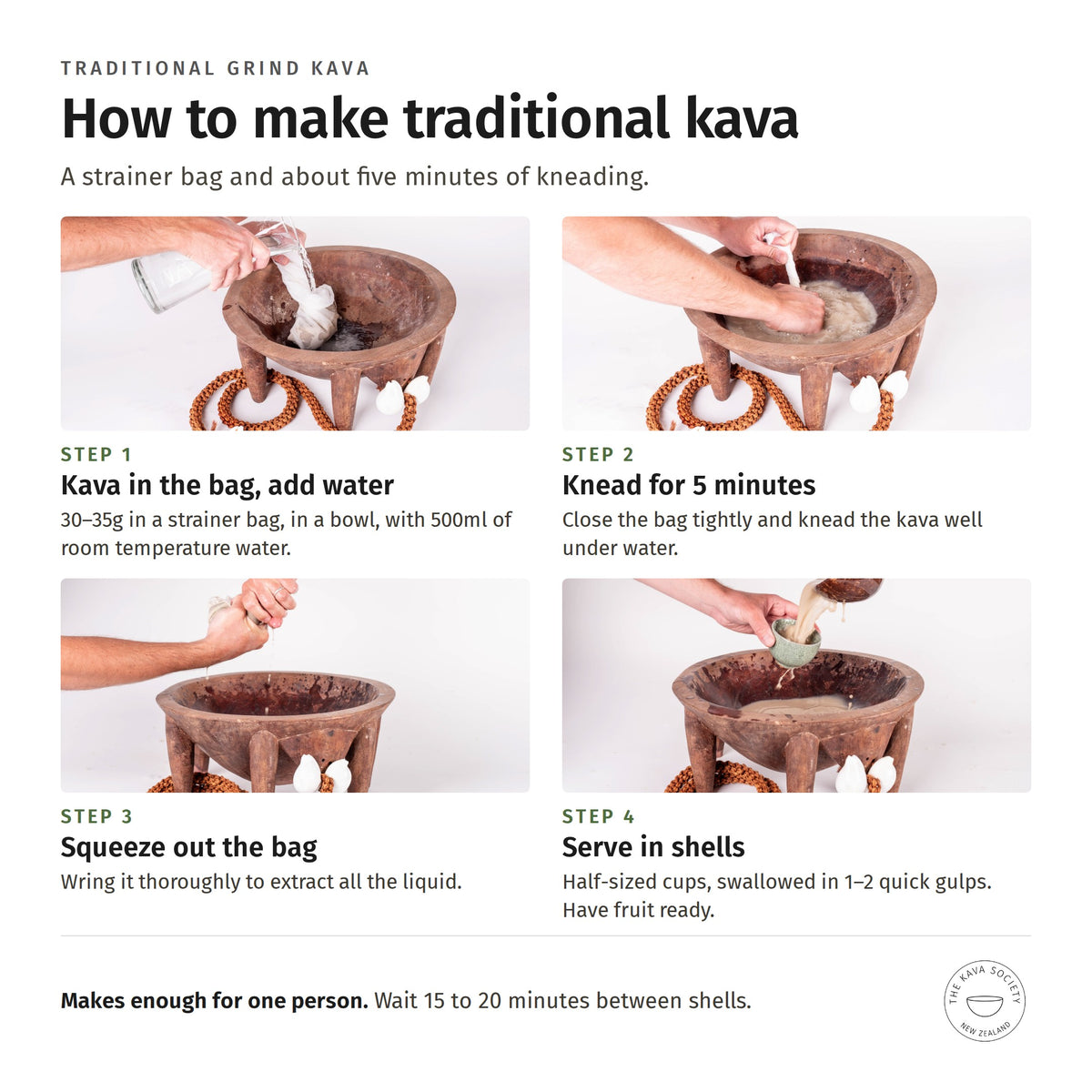
When I do drink kava (4-5 nights per week) I typically drink about 4 tablespoons of root to 2 cups of water and I'm good to go. The thing to keep in mind is that getting hammered should not be the goal. I think this is the beauty of kava: your body will tell you to stop before things get out of hand. I don't really see kava as a party drink at all. For me, it's part of an evening routine that works.
We hope you find these stories interesting. Please treat them for what they are: personal accounts, not scientific studies or medical recommendations. Everyone is different, and if you struggle with serious dependency, anxiety or any other mental health issue, please do talk to a qualified professional. They might be able to help you address the root causes rather than just treat symptoms. If, like many other people, you're simply looking for a calmer evening beverage in the Pacific tradition, hopefully the above gives you a useful sense of what kava can offer.
Drinking kava with, after, or before alcohol
One question we get a lot: is it safe or desirable to mix kava with alcohol, or even drink alcohol shortly before or after kava?
The short answer is no. It's neither healthy nor clearly desirable to drink kava with alcohol, or to consume alcohol shortly after kava. This is primarily because kava can inhibit liver enzymes that are responsible for alcohol metabolism. In simple terms, this means that having kava may potentiate the effects (and side-effects) of alcohol (think bad hangovers and much stronger sedation). It doesn't mean that having a beer a couple of hours after kava will "destroy" you. Some people on the islands of the South Pacific do it (the practice of "washing down" kava with a bit of beer is known as "kale" in Vanuatu and "washdown" in Fiji). However, it's not the safest choice. More importantly, in our view, it largely defeats the purpose of drinking kava: alcohol effects quickly push out the kava effect. The calm alertness is simply replaced or dulled by sedation or intoxication. Mixing the two doesn't produce any interesting synergetic effects. It just results in a poorer kava session, or stronger alcohol effects, or both.
Concluding remarks
We hope this post has been useful for those trying to understand the differences between kava and alcohol, and for those interested in exploring kava as an alternative to drinking. As always, please remember that if you suffer from any serious health problem (including mental health) or take any prescription medication, please consult your doctor first to see whether kava might be a good option for you in your situation. We treat kava as food, a relaxing beverage in the Pacific tradition, not as any kind of remedy or medication. That framing keeps your expectations realistic, and may also encourage you to explore kava's rich history and traditional usage as a social companion and calming sunset beverage.
If you're curious to try a noble Vanuatu kava as a calming evening beverage, you can browse our current selection. If you're not sure where to start, our quick guide for new drinkers walks through the forms, character types, and which cultivars suit different occasions.






Leave a comment
This site is protected by hCaptcha and the hCaptcha Privacy Policy and Terms of Service apply.